Posts

Randomizer your knitting - part 4

Image
So here at last is what we made at Mini Maker Faire in April with the Knitting Wheel of Fortune! Four pure wool scarves, all textured and twisted according to visitors' wheel spins. Many  thanks to Carmen Moran for designing the graphics for the wheel and helping make  Knot Unknot look so fabby on the day.  We also had a small reprise of Attack of the Knitted Tentacle which Carmen and I created in 2010 - enormous fun! Life has run away with a lot of my time recently and this blog has had a bit of a gap  in postings. There have been two main things to report: a move to a larger studio in May and a group exhibition in June. The new space is great and once it's organised it should make a big difference to what I can make and to what you can see at Open Studios  (next one 8 &9 August ). The exhibition looked lovely but after the opening weekend virtually no one came to see it. Ah well, we live and learn. I'll post some photos next time I'm off to the stud...

Randomizer Your Knitting - Part 3

Image
The Knitting Wheel of Fortune is finally taking shape! I'm really looking forward to launching it at Edinburgh's Mini Maker Faire on 19 April. This weekend I acquired some gaming dice and started trying out different stitches. This activity has to be something complex enough to be interesting but reliable and quick enough to be "performance knitting" - not just in public but with a participating audience - and it has to produce something that doesn't look like a waste of yarn. So, a bit of tinkering with the initial conditions is required. I'll be using the Knitmaster Zippy 90.  It's light enough to transport easily and compact when it's set up too. It works with chunky yarns so things will grow quite quickly. There's no punchcard and manual colour changing is very slow so each piece will be one single yarn.  I didn't want to just randomly generate stripes - there are websites that can do that for you, like this very nice one on Biscu...

Randomizer Your Knitting part 2

Image
Following on from my last post about dice decision knitting, I'm now looking at making holes instead of stripes to create a lacey effect. This involves many more decisions than the stripes you have to decide how far apart the holes are, vertically and horizontally. You also have to decide how often to repeat that pattern  before changing to another.  You could also use the dice to set the starting parameters and to decide when to stop. It depends whether you want a wearable piece or a high concept art piece. For the piece in the photos, I set the parameters for a scarf in aran weight yarn and decide to stop after 400 rows or whichever dice decided section brought me close to it. I used different shapes of dice to decide each aspect of the placing of holes. This gave me some control over the process, setting different ranges of outcomes in each case. A purist might  have used the dice to decide which dice to assign to which decision but you run the  risk of devel...

Randomizer your knitting -part 1

Image
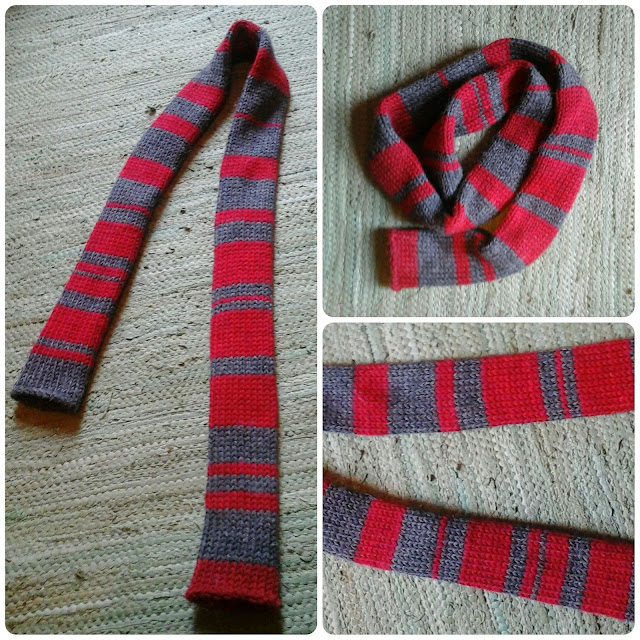
A long long time ago I read Luke Reinhart's The Diceman. It seemed edgy, dodgy  and intriguing to think of living a life controlled by the throw of dice. Not something to apply to real life though - until now! You see, the thing is that you set the parameters before you throw the dice. So you decide on the questions and the set of answers. You can apply the principal locally and have "rigidly defined areas of uncertainty" (to quote Douglas Adams). For example: I have grey yarn and red yarn. What shall I knit? I have a dodecahedral di to help decide. even numbers = scarf,  odds = hat Throw again Evens=holes, odds=stripes I got even,  then odd, so threw to decide the first colour and then the size of each stripe. The scarf finished when on of the yarns ran out. The final outcome is pictured below. Next time we'll see what happened when throw two was even.

Shine on, you crazy knitted flu!

Image
The Shine Dome in Canberra put my knitted neuraminidase on display on 23 January 2015. I'm so pleased that this amazing project has come together so well.  Thank you to Crystals in the City (especially Helen) for inviting me to take part and to Yuri for designing such a great plinth for my work.  And, of course, thank you to the Society of Crystallographers of Australia and New Zealand and the Walter and Eliza Hall Institute for funding the project. It was hard work but enormous  fun and I am delighted to be part of this collection of sculpture celebrating the International Year of Crystallography 2014. 2015 has been designated International Year of Light and I have some fun ideas for marking that with art and craft - just waiting for the funding. If you can help with that then please get in touch.

The Professor's Beanie Hat

Image
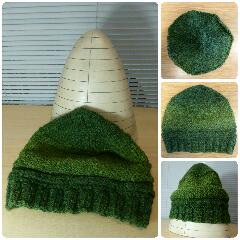
Earlier this year the Scientific Director at my day job moved on to a new post.  As well as a big collective leaving present, some of us thought we'd like to give him more personal souvenirs of his time at ICMS.  One of my colleagues suggested I knit him a new hat to wear while standing outside on his cigarette breaks. So this is what I came up with. As a hat for a mathematician, of course there are mathematical features - simple ones that could be made quickly and which don't detract from a classic shape. There are powers of two in the rib, the Fibonacci sequence in the sides and then a seven-sided (heptagonal) crown.   It's knitted in the round  with one skein of Rowan's Lima, an amazingly soft, baby alpaca yarn that's approximately aran weight.  I picked this colour because it's similar to the ICMS logo colours but it's much richer, with a lot of detail in the drifting shades. Different yarns will work but beware of tension etc.  I don't have...

Knitted flu in Oz!

Image
Happy to say that the knitted neuraminidase is now in Australia,. The Crystals in the City team should have it assembled and on show soon. At the end of the last post I was just about to start stuffing the polystyrene balls into the tubes.  That was a much tougher job than I expected.  The balls fitted neatly in the tubes and so each one of the 1200 of the needed pushed into position individually.  Each  module was a day's work. Then they needed twisted and stitched so all colours were the same shape and interlocked.  Photos above show that. It all got done and packed at the beginning of the month an shipped the day before I left for a conference in Berlin (subject of a future post). Just over a week later I  got word the parcels had all arrived intact.   I'm really looking forward to seeing it installed in its home in Canberra.